Cookie Preferences
We use cookies to enhance your browsing experience, analyze site traffic, and personalize content. By clicking "Accept All", you consent to our use of cookies. Learn more
Neuro-symbolic Intelligence That Learns as It Lives
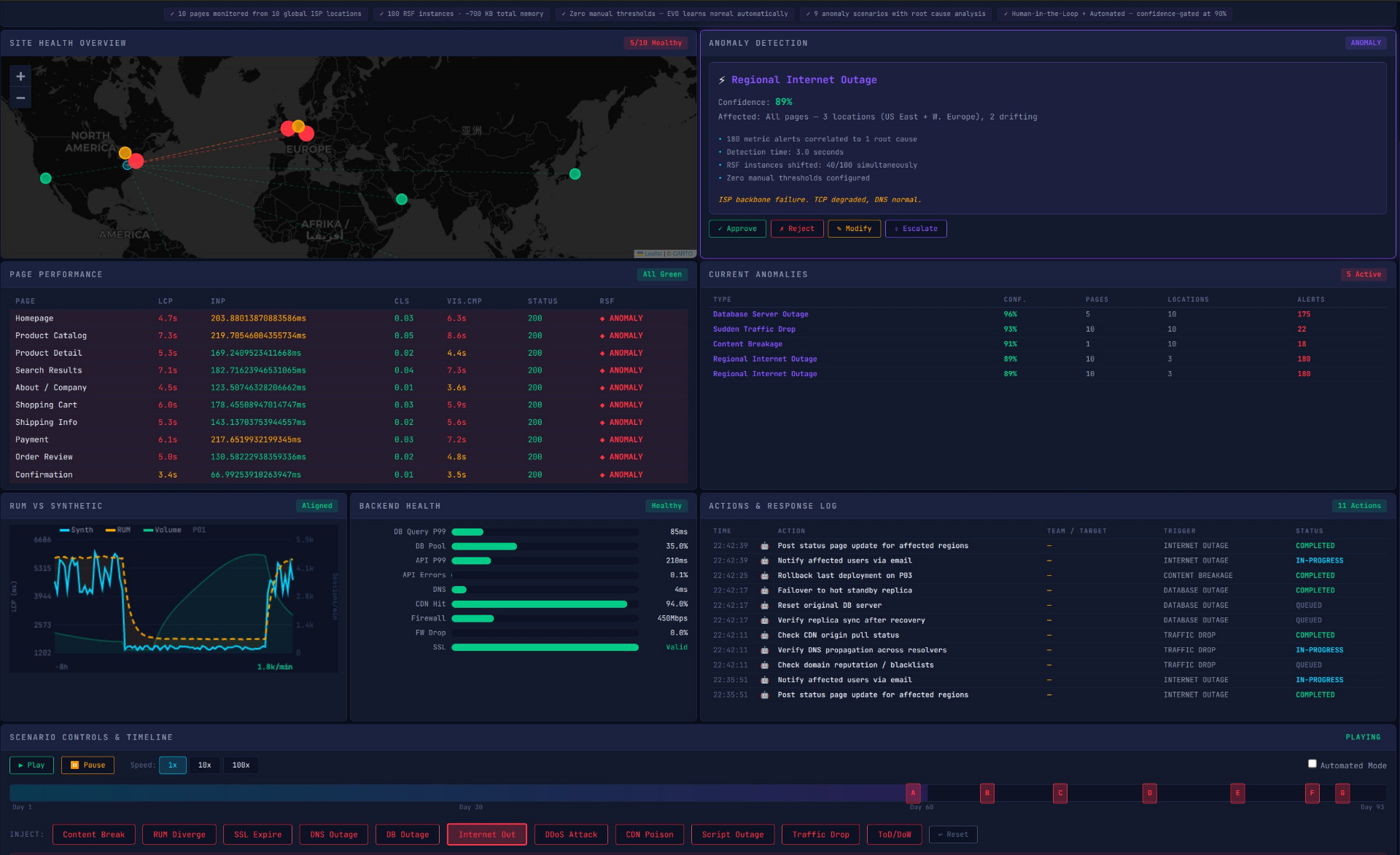
EVO is a neuro-symbolic intelligence platform based on biological and cybernetic principles, designed to analyse complex environments and understand how systems behave. Built on Astermind's neuro-symbolic intelligence architecture, EVO learns continuously from live environments and constructs digital clones of those environments.
EVO constructs digital clones that model the behaviour of the systems being observed. EVO can analyse environments across multiple domains, including data environments and visual environments. Each environment is analysed using specialised intelligence modules known as EVO Capability Modules.
What EVO Enables
EVO enables organisations to analyse complex environments, understand how systems behave and evaluate how those systems respond to change. Built on Astermind's real-time learning approach, EVO allows intelligence to operate continuously alongside the systems it observes. EVO can generate predictions, but extends beyond prediction by evaluating outcomes through simulation.
EVO was specifically designed to replace large language models in mission-critical, real-time data streams — environments where LLM latency, cost and unpredictability make them unsuitable. By learning continuously from live data and operating on lightweight digital clones, EVO delivers deterministic, low-latency intelligence that runs reliably alongside the systems it observes.
Real-Time Intelligence
EVO analyses environments as they operate, allowing organisations to observe system behaviour and identify patterns, signals and anomalies as they emerge.
Simulation Before Change
Potential changes can be evaluated before they are introduced into the environment.
Efficient AI Operation
EVO's runtime models are designed to operate efficiently across cloud, on-premise and distributed environments.
Transparent and Verifiable Results
Outcomes can be traced back to the signals and relationships that influenced the analysis.
Enabling Systems and Decisions
The insights produced by EVO can support downstream systems and operational processes.
How EVO Works
EVO works by learning patterns and relationships from incoming data to continuously update digital clones that represent system behaviour
Ingest Data
EVO accepts data from a wide range of sources including files, sensor outputs, images, structured datasets and unstructured data.
Learn and Evolve the Digital Clone
EVO analyses incoming data to identify patterns, relationships and behavioural signals. As this understanding develops, EVO constructs a lightweight digital clone — also known as a world model — representing the environment being observed. This clone evolves continuously as new data arrives.
Run EVO Capability Modules
EVO Capability Modules execute inference on the digital clone to analyse how the system behaves under different conditions.
Produce Auditable Results
EVO produces results that include the evidence required to validate how the analysis was generated.
Take Instant Action
Based on detected changes and predictions, EVO can act instantly — triggering alerts, executing workflows or driving automated system responses without waiting for human review.
Human-in-the-Loop Learning
For high-impact or ambiguous situations, EVO routes the decision to a human expert. Their input is captured back into the digital clone — so EVO learns from real-world judgment and becomes progressively smarter and more autonomous.
Replay & Analyse Scenarios
Because EVO maintains digital clones, system states can be replayed and analysed to understand behaviour under different conditions.
How EVO Learns
EVO learns by observing real-world environments and continuously refining its understanding of how those environments behave.
Instead of relying on models trained solely on historical datasets, EVO learns continuously from live environments rather than relying on pre-trained models and constructs digital clones that represent how the environment behaves.
The digital clone evolves continuously as new data arrives, allowing EVO to maintain an up-to-date understanding of the system it is analysing.
EVO Capability Modules execute simulations to evaluate scenarios, analyse behaviour and produce validated results that can support downstream actions.
Why EVO Is Different
A fundamentally different approach to intelligence — built on real-time learning, digital clones and simulation. EVO turns insight into outcomes through instant automated action or human-in-the-loop learning that makes it smarter every day.
More Efficient AI Runtime
The Problem
Many AI platforms rely on large models, repeated API calls and compute-intensive infrastructure. EVO uses a highly efficient neural architecture that dramatically reduces the resources required, unlike traditional neural networks that require backpropagation.
Impact
- 99% faster AI execution than typical API-based model calls
- 30% fewer model calls when interacting with existing AI models
- Models up to 90% smaller than typical LLM architectures
- Up to 90% lower memory and GPU usage
- No large GPU infrastructure required
Lower Infrastructure Footprint
The Problem
EVO's architecture requires significantly less compute, memory and infrastructure than traditional AI systems.
Impact
- 99% faster AI execution than typical API-based model calls
- Models up to 90% smaller than typical LLM architectures
- Up to 90% lower memory and GPU usage
- No large GPU infrastructure required
Adaptive Intelligence
The Problem
Built on Astermind's real-time learning approach, EVO allows intelligence to evolve as systems and conditions change, reducing dependence on model retraining cycles.
Impact
- Intelligence based on live environmental behaviour
- Faster adaptation to changing conditions
- 30% fewer model calls when interacting with existing AI models
Simulation-Driven Decisions
The Problem
EVO evaluates potential outcomes through simulation, allowing organisations to evaluate decisions before taking action and reducing operational risk.
Impact
- Evaluate decisions before taking action
- Reduce operational risk through simulation
- Intelligence based on live environmental behaviour
Flexible Deployment Including Air-Gapped Environments
The Problem
EVO can run across cloud platforms, on-premise infrastructure and fully air-gapped environments, allowing organisations to deploy intelligence in locations where traditional AI systems cannot operate.
Impact
- Deploy intelligence in secure and regulated environments
- Support organisations that cannot rely on external AI services
- Reduce infrastructure dependencies and operational risk
- Enable AI deployment across critical systems
Deeper Understanding of Complex Environments
The Problem
EVO constructs digital clones that represent how systems behave, enabling deeper understanding of relationships, dependencies and behaviour across complex environments.
Impact
- Represent system behaviour including relationships, patterns and dynamics
- Evolve continuously as new data is observed
- Enable replay and scenario analysis
EVO Capability Modules
Each EVO Capability Module is designed to analyse a specific type of environment while operating within the EVO platform's neuro-symbolic intelligence architecture. This allows different forms of intelligence to operate within the same platform while sharing the same learning framework, simulation capability and evidence model.
Data Normalization Module
Analyses environments composed of structured and unstructured data such as operational systems, application platforms, data pipelines and infrastructure telemetry.
Anomaly Detection Module
Adds domain-specific interpretation on top of EVO's universal anomaly substrate, including threat classification, MITRE ATT&CK mapping and SOC-scale detection logic.
Vision Module
Analyses environments observed through visual data such as images and video, including monitoring, navigation and safety systems. Includes RSF + ELM image classifier for high-throughput visual classification workloads, with optional GPU acceleration.
Analytics & Observability Module
Drift watch, evidence promotion, counterfactual replay, RSF resonance, margin desk health and noise schedule analytics for production AI environments.
Predictive & Risk Module
Forecasting and operational, financial, third-party and geopolitical risk-signal correlation for insurance, banking and enterprise risk teams.
Orchestration & Actuation Module
Agentic AI orchestration layer that coordinates EVO Capability Modules, external AI services and downstream systems, turning validated intelligence into autonomous actions, workflows and system responses.
Deployment Models
Deploy where your systems operate — without being constrained by infrastructure or external AI services
Cloud Deployment
Operate within cloud environments alongside existing infrastructure and AI services.
On-Premise Deployment
Run within on-premise infrastructure, directly on devices and within operational systems.
Air-Gapped Deployment
Operate within fully isolated environments without external AI services or internet connectivity.
Hybrid AI Deployment
Operate alongside existing AI platforms as an optimisation layer coordinating with external systems.
Beyond Traditional AI
EVO takes a fundamentally different approach, built on Astermind's real-time learning paradigm
Traditional AI Approach
AsterMind EVO Approach
Models trained on historical datasets
Learns continuously from live environments
Generates predictions from patterns
Evaluates outcomes through simulation
Large GPU infrastructure required
Up to 90% lower memory and GPU usage
Cloud-dependent operation
Cloud, on-premise or fully air-gapped
Retraining required when conditions change
Adapts continuously without retraining
Opaque decision outputs
Transparent, traceable and verifiable results
Efficient AI Runtime
Faster Execution
Than typical API-based model calls
Smaller Models
Than typical LLM architectures
Fewer Model Calls
When interacting with existing AI models
Lower GPU Usage
No large GPU infrastructure required
Frequently Asked Questions
Common questions about the EVO Platform