What is an Extreme Learning Machine (ELM)?
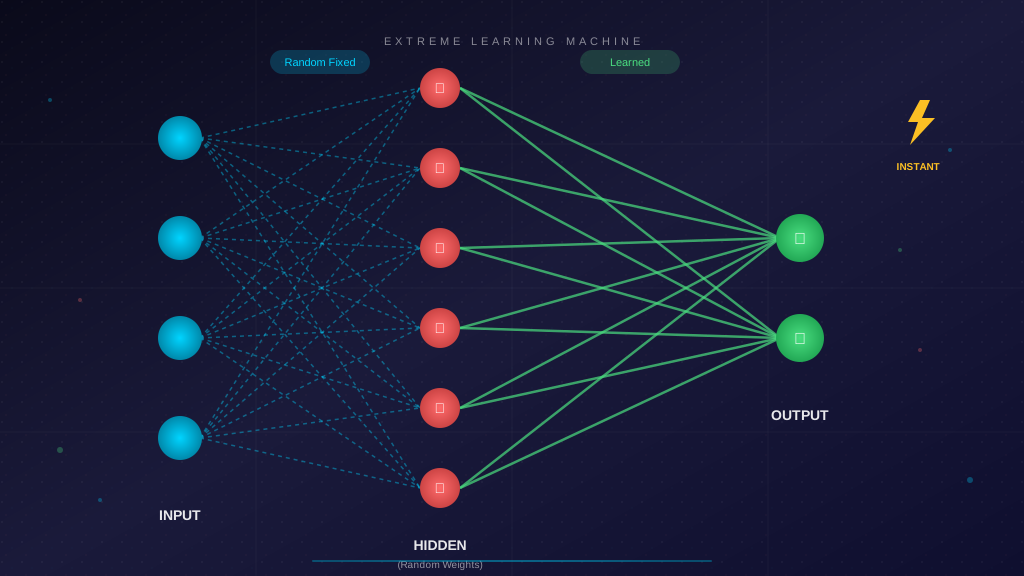
A deep dive into the neural network architecture that's bringing instant, privacy-first machine learning to the browser
Introduction
In the world of artificial intelligence and machine learning, speed and efficiency often come at a cost—massive computational resources, complex infrastructure, and significant training time. But what if there was a neural network architecture that could train in milliseconds, run entirely in your browser, and deliver predictions with microsecond latency?
Enter the Extreme Learning Machine (ELM)—a revolutionary approach to neural networks that's changing how developers think about deploying AI in frontend applications.
Understanding Neural Networks: A Quick Primer
Before diving into ELMs, let's briefly revisit how traditional neural networks work.
A conventional neural network consists of three main components:
- Input Layer — Receives the raw data
- Hidden Layer(s) — Processes and transforms the data through weighted connections
- Output Layer — Produces the final prediction or classification
During training, these networks use backpropagation—a process that iteratively adjusts all the weights across every layer to minimize prediction errors. While effective, this approach has significant drawbacks:
- Slow training times — Often requiring hours, days, or even weeks
- Massive computational requirements — GPUs, TPUs, and cloud infrastructure
- Hyperparameter tuning — Learning rates, momentum, epochs, and more
- Local minima problems — Getting stuck in suboptimal solutions
This is where Extreme Learning Machines offer a fundamentally different approach.
What is an Extreme Learning Machine?
An Extreme Learning Machine (ELM) is a type of single-hidden-layer feedforward neural network (SLFN) that was originally proposed by Professor Guang-Bin Huang at Nanyang Technological University in Singapore in 2006.
The revolutionary insight behind ELM is elegantly simple:
What if we don't train all the weights?
In an ELM, the weights between the input layer and the hidden layer are randomly initialized and never changed. Only the weights between the hidden layer and the output layer are computed—and this is done using a closed-form solution (specifically, the Moore-Penrose pseudoinverse) rather than iterative gradient descent.
How ELM Works
- Random Initialization — The input-to-hidden weights are randomly assigned once and fixed permanently
- Hidden Layer Activation — Input data is transformed through the hidden layer using these random weights
- Closed-Form Solution — The hidden-to-output weights are calculated analytically in a single step using matrix mathematics
- Instant Prediction — The trained model can immediately make predictions
This approach eliminates the need for:
- Backpropagation
- Learning rate tuning
- Multiple training epochs
- Gradient computation
The result? Training that takes milliseconds instead of hours.
ELM vs. Traditional Neural Networks
| Aspect | Traditional Neural Networks | Extreme Learning Machine |
|---|---|---|
| Training Method | Iterative backpropagation | Closed-form analytical solution |
| Training Speed | Minutes to weeks | Milliseconds |
| Parameters to Tune | Many (learning rate, momentum, epochs, etc.) | Few (hidden units, activation function) |
| Weights Updated | All layers | Output layer only |
| Computational Requirements | Often requires GPUs | Runs on CPU, even in browsers |
| Risk of Local Minima | Yes | No (deterministic solution) |
| Explainability | Black box | More transparent |
The AsterMind-ELM Advantage: Pure JavaScript Implementation
While ELM implementations exist in Python and other languages, AsterMind-ELM takes a unique approach: it's fully implemented in JavaScript without any third-party packages.
This isn't a Python library with a JavaScript wrapper—it's been built from the ground up in pure JavaScript and TypeScript for the modern web.
Why Pure JavaScript Matters
1. True Browser-Native Execution
Because AsterMind-ELM has zero external dependencies, it runs entirely in the browser without any server communication. This means:
- No API calls to external ML services
- No data ever leaves the user's device
- No latency from network round-trips
- Works completely offline
2. Privacy-Preserving by Design
In an era of increasing data privacy concerns and regulations like GDPR, running machine learning on-device is a game-changer. With AsterMind-ELM:
- Sensitive data never touches a server
- No cloud infrastructure to secure
- Perfect for healthcare, finance, and regulated industries
- Users maintain complete control over their data
3. Zero Infrastructure Overhead
Traditional ML deployments require:
- GPU servers or cloud ML services
- API endpoints and authentication
- Load balancing and scaling
- Ongoing operational costs
With a pure JavaScript ELM implementation:
- No servers to maintain
- No GPUs required
- No DevOps complexity
- Computation happens on the user's device
4. Instant Integration for JavaScript Developers
Frontend developers can integrate machine learning without:
- Learning Python
- Setting up ML infrastructure
- Managing model serving
- Dealing with cross-language interoperability
Simply install via NPM and start building intelligent features directly in your JavaScript or TypeScript application.
5. Minimal Bundle Size
Without third-party dependencies, AsterMind-ELM maintains a small footprint—critical for web performance where every kilobyte matters for load times and user experience.
6. Predictable, Deterministic Behavior
Pure JavaScript implementation means:
- No hidden dependencies that could break
- No version conflicts with other packages
- Consistent behavior across environments
- Easier debugging and maintenance
What Can You Build with ELM?
Despite being lightweight, Extreme Learning Machines are surprisingly capable. AsterMind-ELM enables:
Classification Tasks
- Sentiment analysis
- Spam detection
- Image classification
- User behavior categorization
Regression Tasks
- Price prediction
- Trend forecasting
- Scoring systems
Real-Time Applications
- Voice command recognition
- Gesture detection
- Live data classification
- Interactive UI adaptation
On-Device Intelligence
- Personalized recommendations (without tracking)
- Smart form validation
- Anomaly detection
- Pattern recognition
Beyond Basic ELM: Advanced Capabilities
AsterMind extends the basic ELM architecture with additional capabilities:
Kernel ELM (KELM)
While standard ELMs use a grid-like approach to map data, Kernel ELMs use landmark-based mapping. Think of it like navigating a city—instead of using a grid coordinate system, you use recognizable landmarks ("the bank is near the big tree, across from the park").
KELM is particularly effective for:
- Non-linear classification problems
- Complex pattern recognition
- Situations where standard ELM needs enhancement
Online Learning
Traditional models are static after training. AsterMind-ELM Premium supports continual learning—the model can adapt and improve as new data arrives, detecting drift and requesting labels when needed.
Model Chaining
Multiple ELM models can be chained together like building blocks, enabling complex workflows while maintaining the speed and simplicity of individual models.
Explainable AI: Understanding Your Model's Decisions
One of the most significant advantages of ELM is explainability. Unlike deep learning black boxes, ELM's deterministic mathematical foundation provides:
- Transfer Entropy metrics — Understand information flow in your model
- Symbolic event logs — Track exactly how decisions are made
- Transparent architecture — No hidden layers of complexity
For regulated industries and applications where you need to justify AI decisions, this transparency is invaluable.
Getting Started with AsterMind-ELM
AsterMind offers multiple tiers to match your needs:
Community Edition (Free & Open Source)
- Core ELM functionality
- NPM package installation
- Browser and Node.js support
- MIT license
Pro Edition
- Kernel ELM (KELM) support
- Online learning capabilities
- Ensemble methods
- Priority support
Premium Edition
- Self-regulating AI architecture
- Novelty detection
- Human-in-the-loop adaptation
- Advanced symbolic interfaces
Conclusion: The Future of Frontend AI
Extreme Learning Machines represent a paradigm shift in how we think about deploying machine learning. By eliminating the need for iterative training, massive computational resources, and complex infrastructure, ELM opens the door to a new generation of intelligent web applications.
AsterMind-ELM takes this further by providing a pure JavaScript implementation that runs entirely in the browser. No servers, no GPUs, no Python—just fast, explainable intelligence that respects user privacy and works offline.
As AI becomes increasingly embedded in our digital experiences, the ability to run machine learning on-device, with millisecond training and microsecond inference, isn't just convenient—it's transformative.
Ready to bring instant AI to your frontend applications?
Explore AsterMind-ELM and discover what's possible when machine learning runs where you need it. Learn more about how this technology powers the EVO Platform.
AsterMind brings instant, tiny, on-device ML to the web. Train models in milliseconds, predict with microsecond latency, and run entirely in the browser—no GPU, no server, no tracking.